Robert Grim Awarded With Kutztown University President’s Medal
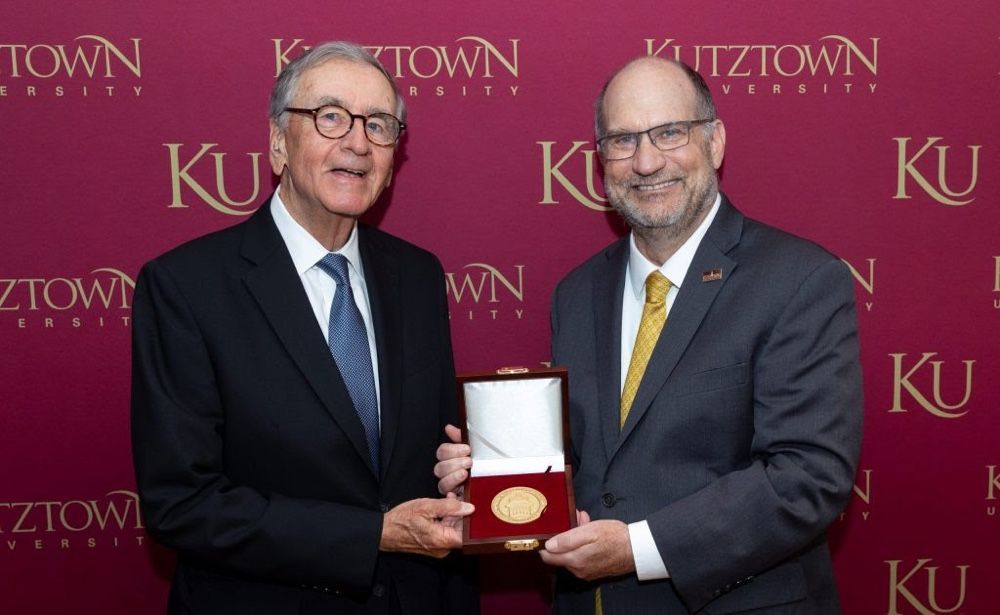
Robert Grim receiving Kutztown University President's Medal Award.

Kutztown University, June 24, 2025


Robert Grim, Esq., was presented with the Kutztown University President’s Medal on Tuesday, June 24, for his commitment to service to Kutztown University and the local community.


A lifelong resident of Kutztown, Grim has practiced law locally since 1969, following his graduation from Lafayette College and Villanova Law School. His legal career commenced as an assistant public defender in Berks County, and he has since served as a municipal solicitor in the area for over four decades.


Grim’s commitment to Kutztown University is both personal and profound. He grew up at 15195 Kutztown Road, formerly known as Maple Manor, which houses the KU Foundation’s Business Office. This residence, recently renamed The Grim Family Homestead, stands as a testament to the family’s longstanding relationship with the university.


The Grim family’s legacy at Kutztown dates back to the 1880s. His great-grandfather, Dr. George Washington Grim, had nine children, all of whom attended the Keystone State Normal School (now Kutztown University). Among them, James S. Grim, Robert’s grandfather, graduated in 1893 and dedicated 43 years to teaching at the institution. His contributions to education and groundbreaking botanical research led to the naming of the Grim Science Building in his honor.


Continuing this tradition of service, Grim co-founded the Kutztown University Foundation, where he also served as director and treasurer. His efforts have been pivotal in advancing the university’s fundraising and development initiatives. He has helped establish two scholarships at the university: the Ruth S. Grim Leestma 1932 and the 1934 Memorial Endowed Scholarship for Elementary School Teachers, and the Honorable Allan K. Grim 1921 Memorial Endowed Scholarship.


He has also served on the Council of Trustees, holding the positions of vice chairperson (2020-22) and chairperson (2022-24), providing strategic guidance during pivotal periods. During his time as chair and beyond, Grim has been an advocate for green efforts for the university and Kutztown community, pursuing solar energy while preserving the local environmental footprint.


Beyond his roles at the university, Grim has demonstrated a steadfast commitment to community service. He has held leadership positions with the Berks County Bar Association, the Berks County March of Dimes, the Kutztown Business Association, and the Kutztown Area Historical Society. Additionally, he co-founded and presided over the Kutztown Area School District Educational Foundation, emphasizing his dedication to education at all levels.


Grim’s contributions have been recognized with the Kutztown Outstanding Community Citizen Award, reflecting his impact and service. His family’s legacy, marked by generations of educators and public servants, underscores a deep-seated commitment to the betterment of society through education and civic engagement.


The President’s Medal was created in 2014 by the president’s office to be awarded to individuals who bring honor and distinction to our institution and who serve as examples to our students and our alumni. Other recipients include William Ribble ’73, long-time member of the KU Foundation Board; Andre Reed ’05, KU and Pro Football Hall of Famer; Ryan Vogelsong, Major League Baseball All-Star and two-time World Series Champion; Gregory “Doc” Jones, long-time head coach of the KU men’s rugby team; Dr. Carlson Chambliss, long serving KU professor, philanthropist and scholar; Sandy Green, former mayor of Kutztown and community leader and advocate; Bessie Reese Crenshaw ’50, Kutztown University’s first African American graduate; John Mobley, two-time Super Bowl champion; Robert C. Landis and Scott A. Dorn ’79, KU Foundation Board presidents; Bonita B. Perkins ’68 and Charles O. Perkins ’68, philanthropic leaders and supporters; and Jason Graver ’92, M’18, volunteer university historian.


Learn more about the Kutztown University President's Medal here


News & Information

By Mahlon Boyer May 30, 2026
Business succession planning is an important process that helps business owners prepare for the upcoming transfer of ownership and leadership. Whether the transition involves passing the company to family members, selling to business partners or transferring ownership to outside buyers, having a clear succession plan helps reduce uncertainty and protect the long-term security of the business. A careful plan can also minimize disputes, preserve business value and ensure continuity in periods of change. Planning for Business Transfer The first step in business succession planning is identifying how the business will be transferred and who will assume control. Business owners should evaluate their long-term goals, retirement plans, and the financial needs of both the company and their family members. Some owners choose to pass the business on to children or relatives who are already involved in operations. Others may transfer ownership to key employees, business partners or third party buyers. Each option has different legal, operational and financial consequences. A successful transition often takes years of preparation. Potential successors may need leadership training, operational experience and gradual increases in responsibility to ensure they are ready to effectively manage the business. Good communication with family members, partners and stakeholders is also important to avoid misinterpretations and conflict. Business owners should work with legal and financial professionals to create formal succession documents, update corporate records, and establish a realistic timeline for the transfer process. Use of Buy-Sell Agreements Buy-sell agreements are an essential part of many succession plans. These legally binding agreements specify what happens to the interest of a business owner if certain events occur, such as retirement, disability, death or voluntary departure from the company. A buy-sell agreement typically defines who may buy the shares of the departing owner, how the business interest will be valued and the terms of payment. This structure helps maintain stability and prevents ownership disputes that could disrupt operations. For businesses with multiple owners, buy-sell agreements provide understanding and protections for all parties involved. They can prevent unwanted external ownership and ensure that remaining owners retain control of the company. Funding mechanisms are also important. Many businesses use life insurance policies to fund buyouts in the event of an owner's death. This allows surviving owners or family members to complete the transfer without putting financial hardship on the business. Tax Considerations Tax planning is an important part of business succession planning. If the transfer of ownership is not well planned, the business owner and successor will face a substantial tax liability. Depending on how the transfer takes place, the owners may face capital gains, estate, or gift taxes. With good planning, these tax burdens can be reduced with trusts, step-by-step ownership transfers, family partnerships, or changing the type of business entity. Another important factor is valuation. A proper valuation of a business is important for determining tax liability and ensuring that everyone involved in the transfer is treated fairly. Business owners should regularly review their succession plans with accountants, tax advisors, and attorneys, as tax laws are often changing. Regular updates keep the plan in line with changing legislation and the business’s needs. Let Us Help You Navigate the Essentials of Business Succession Planning Don’t wait! Talk to one of the experienced estate planning attorneys at Bingaman Hess today at 610.374.8377 or contact us online. This article is for informational purposes only and does not constitute legal advice. No one may rely on this information without consulting an attorney. Anyone who attempts to use this information without attorney consultation does so at their own risk. Bingaman Hess is not and shall never be responsible for anyone who uses this information. It is not legal advice.
Contact the PA Real Estate Lawyers at Bingaman Hess for Help in Developing Mixed-Use Properties
By Mahlon Boyer May 23, 2026
Learn the key considerations in developing mixed-use properties, including zoning and planning requirements, legal challenges, and effective community engagement strategies.
Contact our Pennsylvania estate attorneys for assistance with guardianship documents.
By Mahlon Boyer May 16, 2026
Learn how contested guardianships are handled, including legal challenges, the rights of all parties involved, and the court procedures used to resolve disputes.
Contact the attorneys at Bingaman Hess for Corporate Formation assistance.
By Mahlon Boyer May 9, 2026
Learn how to choose the right business entity structure by comparing LLCs, S-Corps, and C-Corps, state incorporation benefits, and essential formation documents.
Contact our attorneys for help with mergers and acquisitions throughout Pennsylvania.
By Mahlon Boyer April 25, 2026
Learn how to navigate mergers and acquisitions with due diligence, deal structuring, tax efficiency, and post-merger integration strategies.
By Mahlon Boyer April 18, 2026
Learn how to manage risk in real estate transactions, from identifying potential issues to using insurance and legal strategies for protection.
Contact our municipal attorneys about licensing and permits in Berks County, PA.
By Mahlon Boyer April 11, 2026
Learn how to navigate municipal licensing and permits, streamline approval processes, and maintain compliance to avoid delays, fines, and project disruptions.
Power of Attorney and Guardianship differ in how they are established, authority granted and more.
By Mahlon Boyer April 4, 2026
Understand the key differences between power of attorney and guardianship, including legal authority, applicability, and how to choose the best option for your situation.
Contact the Attorneys at Bingaman Hess for Advice on Property Taxes
By Mahlon Boyer March 31, 2026
Learn how property taxes affect real estate investments, including strategies for appealing assessments, using tax exemptions, and legally reducing tax liabilities.
More Posts